When militants struck two distant points in Burkina Faso on the same day, the pattern behind the violence became clearer than any single battlefield report. On Saturday 26 September, a Burkinabè soldier was killed during an assault on a military position in Lalgaye, in the Koulpélogo province of the Centre-Est region. Hundreds of kilometres away, around Ouahigouya in the north, coordinated incursions destroyed heavy equipment. The claim of responsibility, issued on Thursday 1 October by the Group for the Support of Islam and Muslims (JNIM), did more than confirm the operations — it exposed the sustained pressure armed groups continue to place on Burkina Faso’s Defence and Security Forces.
Why Lalgaye became a target
Saturday 26 September brought a sharp spike in violence to Koulpélogo province. The commune of Lalgaye, roughly twenty kilometres from Ouargaye, found itself at the centre of a direct assault on a Burkinabè army checkpoint.
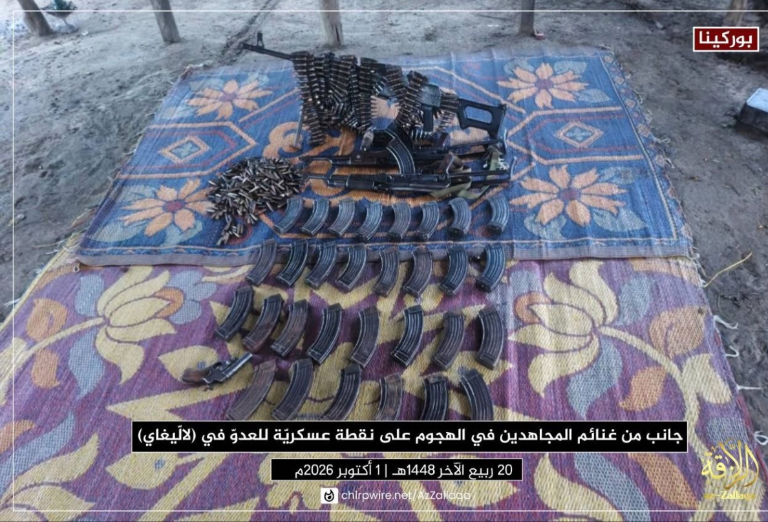
According to cross-checked accounts and the official statement released on Wednesday 1 October through JNIM’s propaganda channels — the Sahel branch of Al-Qaeda — a heavily armed group overran the installation. The defenders fought back hard, but the attackers’ superior numbers and the element of surprise allowed them to breach the compound.
The human toll: one soldier killed in combat. Before withdrawing towards the surrounding wooded areas, the assailants looted the post, taking a substantial haul of small arms, ammunition and individual equipment. This method of operation, now common in the region, serves two purposes at once: weakening local security coverage and resupplying militant columns with military logistics.
Coordinated pressure in the north: Ouahigouya under strain
At the very moment the Centre-Est was coming under attack, the country’s north was absorbing similar offensive pushes. In the Nord region, around the strategic city of Ouahigouya — capital of both the region and Yatenga province — two positions held by the army and its civilian auxiliaries were taken under fire.
While the human toll from these northern incursions remains incomplete, material losses are confirmed: at least one light armoured military vehicle was destroyed by heavy weapons fire or an improvised explosive device. The spatial and temporal coordination of these strikes — carried out on the same day, several hundred kilometres apart — points to an operational planning capacity that the militant coalition has retained.
The logic of harassment and resupply
The Lalgaye attack fits into a particularly complex security landscape in Koulpélogo. This province, which borders Togo and Ghana, forms a strategic corridor for JNIM, which is seeking to establish transit zones and rear bases between Burkina Faso’s Est region and the countries of the Gulf of Guinea.
For specialists in the Sahel conflict, the storming of isolated posts is part of a tactical harassment strategy. By multiplying targeted raids against small detachments, jihadist groups pursue a threefold objective:
- Material attrition: capturing weapons, vehicles and communications equipment without depending on heavy external logistics flows.
- Territorial isolation: forcing government forces to withdraw towards major urban centres — Tenkodogo or Ouargaye in the Centre-Est, Ouahigouya in the Nord — thereby creating security “black holes” in rural areas.
- Psychological warfare: using the delayed release of claims, such as the one published on 1 October, to sustain a permanent sense of insecurity and contradict the transitional authorities’ official messaging.
How the security forces responded
Faced with this renewed tension, the Burkinabè Armed Forces and the Volunteers for the Defence of the Homeland immediately launched clearance and pursuit operations. Air assets were deployed in the Koulpélogo region and the Yatenga sector to track fleeing enemy columns.
In Ouagadougou, the transitional authorities regularly reaffirm their determination to continue reclaiming territory. Yet these recent events underline the logistical and human challenges facing units on the ground, often confronted with asymmetric attacks and the widespread use of explosive devices on road axes.
Local populations in the Lalgaye area, meanwhile, live under the threat of repeated incursions. As security operations continue in Koulpélogo, the price paid by the armed forces is a reminder of the harsh daily combat being waged to restore Burkina Faso’s territorial integrity.